

Some women describe it as being tired and wired at the same time. Others say they feel like a phone stuck at 3% battery, or like their body is bracing for something that never arrives. They are doing everything right on paper, and their body still won’t settle.
There is a name for this. Nervous system dysregulation is what happens when the body’s stress response stops switching off the way it was designed to. It is not a character flaw, and it is not “all in your head.” It is a body doing exactly what it learned to do in order to keep you safe.
What Is Nervous System Dysregulation?
Your autonomic nervous system runs the things you don’t consciously control: heart rate, breathing, digestion, sleep, and your response to danger. It has two main branches. The sympathetic branch speeds you up so you can meet a challenge. The parasympathetic branch slows you down so you can rest, digest, and repair.
A regulated nervous system moves between these states as life requires. You feel stress before a hard conversation, and then you come back down. Nervous system dysregulation means that flexibility has been lost. The system gets stuck on high alert, collapses into shutdown, or swings between the two with very little in between.
It helps to be clear about what the term is and isn’t. Nervous system dysregulation is a descriptive phrase that clinicians use, not a formal diagnosis. It overlaps with recognized conditions, including the arousal and reactivity symptoms of PTSD described by the VA’s National Center for PTSD, as well as anxiety and depression.
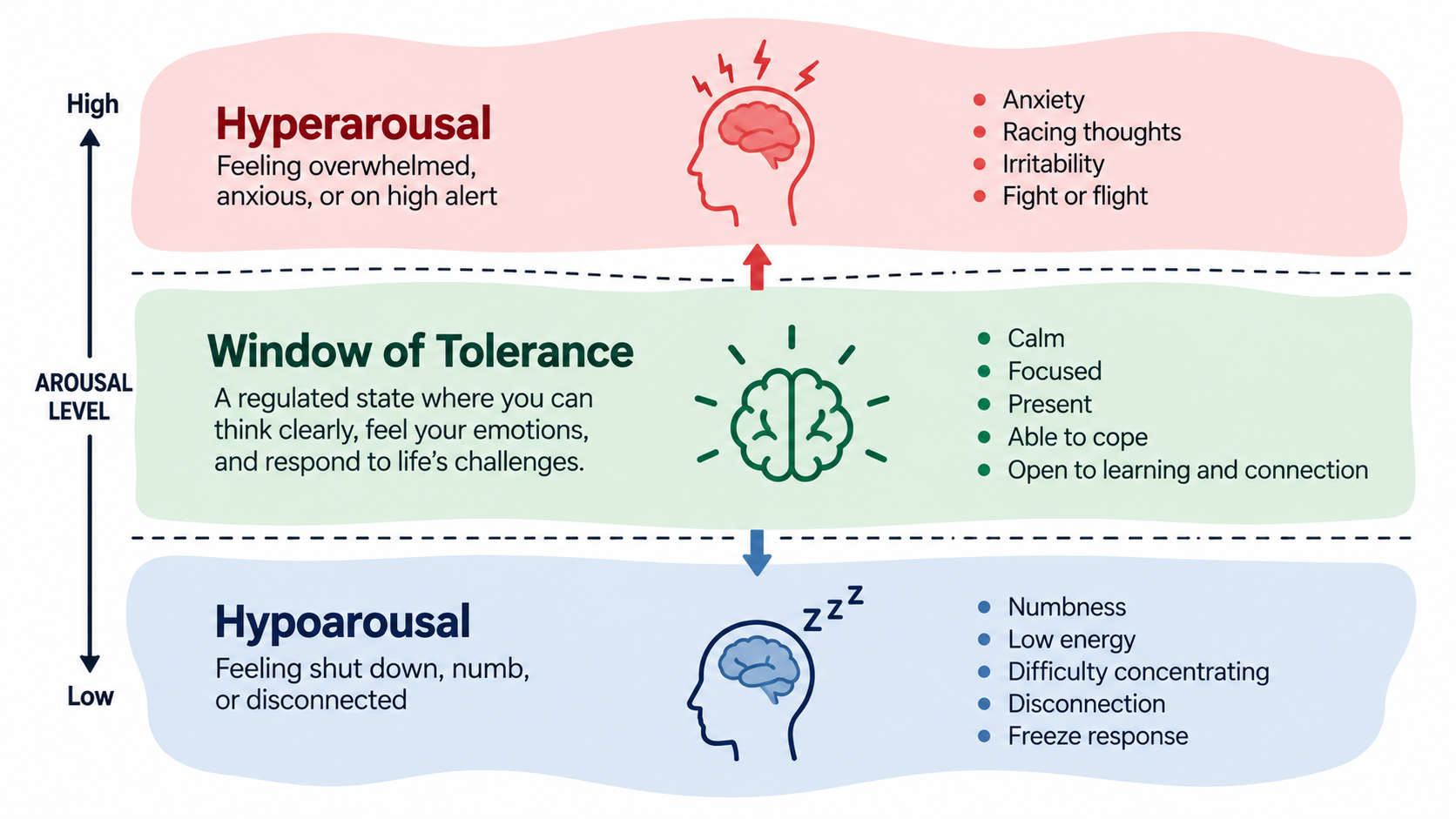
Many therapists explain it using the “window of tolerance,” a concept introduced by psychiatrist Dr. Dan Siegel in 1999. Inside your window, you can feel strong emotions and still think clearly. Above it, you are in hyperarousal. Below it, you are in hypoarousal. Chronic stress and trauma narrow the window, so it takes less and less to push you out of it.

Signs of a Dysregulated Nervous System
A dysregulated nervous system does not look the same in every woman. Most recognize themselves in one of two patterns, and many move between both.
Signs of hyperarousal (stuck “on”):
- Feeling constantly on edge or unable to relax, even when nothing is wrong
- Startling easily at sounds, touch, or sudden movement
- Racing thoughts and trouble falling or staying asleep
- Irritability or anger that feels out of proportion
- A tight chest, clenched jaw, or shallow breathing
- Scanning rooms, faces, and tones of voice for signs of danger
Signs of hypoarousal (stuck “off”):
- Feeling numb, flat, or disconnected from your own life
- Heavy fatigue that sleep does not fix
- Brain fog and difficulty making simple decisions
- Pulling away from people you love
- Going blank or “checking out” during conflict
The body often speaks first. Digestive trouble, tension headaches, a racing heart, and feeling run down are common companions. Because these symptoms can also come from thyroid conditions, anemia, hormonal changes, and disorders of the autonomic nervous system itself, it is worth seeing a medical provider to rule those out.
Why Nervous System Dysregulation Is So Common in Women
Dysregulation is an adaptation. A nervous system that has lived through danger, or through years of pressure with no recovery, learns to stay ready. For many women, there has been a great deal to stay ready for.
- Trauma. According to the National Center for PTSD, about 8 of every 100 women will have PTSD at some point in their lives, compared with about 4 of every 100 men.
- Childhood adversity. CDC data show that 19.2% of women report four or more adverse childhood experiences, compared with 15.2% of men. Early stress shapes a developing nervous system, which is one reason complex trauma in women so often shows up in the body.
- Chronic stress without recovery. Caregiving, work, and carrying the emotional weight of a household can keep the stress response switched on for years. If you want the physiology, we cover it in how stress affects your body.
- Coping that backfires. Alcohol, sedatives, and stimulants change how the nervous system feels in the moment. Over time they make it harder for the body to regulate on its own.
How to Regulate Your Nervous System: What the Research Supports
You cannot think your way out of a nervous system state. Regulation is learned through the body, in small doses, repeated often. These are the practices with the most evidence behind them.
Slow breathing with a long exhale. A Stanford trial published in Cell Reports Medicine found that five minutes a day of breathwork improved mood, and that “cyclic sighing” (two inhales through the nose followed by a long, slow exhale) did so more than mindfulness meditation. A 2022 meta-analysis of 223 studies found that slow breathing increases heart rate variability, a marker of parasympathetic activity.
Trauma-informed movement. In a randomized trial of 64 women with chronic, treatment-resistant PTSD, 52% of those who took ten weeks of trauma-informed yoga no longer met criteria for PTSD, compared with 21% of the control group.
Deep rest. A nervous system that has been running for years needs practice at stopping. Guided rest practices such as yoga nidra teach the body what settling feels like.
Safe connection. Human nervous systems regulate in the company of other regulated people. A calm voice, steady eye contact, and unhurried time with someone you trust do real physiological work.
Rhythm. Regular meals, consistent sleep and wake times, daylight, and time outdoors give the body predictable signals that it is safe.
For tools to use in a hard moment, see our guide on what to do when you’re triggered.
One note on the science. Much of the popular language around this topic comes from polyvagal theory, introduced by Dr. Stephen Porges in the 1990s. It is widely used in trauma therapy, and parts of it are still debated by researchers. The practices above stand on their own evidence either way.
When Self-Regulation Isn’t Enough
Breathing exercises can widen your window. They cannot, on their own, resolve what narrowed it. When dysregulation is rooted in trauma, the body keeps returning to its old settings until the trauma itself is processed.
It may be time for professional support if:
- Symptoms have lasted for months and are not easing
- Sleep, work, parenting, or relationships are suffering
- You rely on alcohol, medication, or food to come down or to feel something
- You feel numb or disconnected much of the time
- You have thoughts of harming yourself
If you are in crisis, call or text 988 to reach the Suicide and Crisis Lifeline, available 24 hours a day.
Treatment that addresses the root usually combines trauma-processing therapy, such as EMDR, with body-based work like Somatic Experiencing, so that the mind and the body heal together.
How Villa Kali Ma Helps Women Heal a Dysregulated Nervous System
At Villa Kali Ma, nervous system regulation is not an add-on to therapy. It is built into every day of treatment. Our programs are women-only, and they pair evidence-based clinical care with practices that teach the body to feel safe again.
Alongside individual and group therapy, women in our care practice TRE and neurogenic yoga, breathwork, trauma-informed yoga, acupuncture, massage, and mindfulness-based stress reduction.
For women who need time away from daily life to reset, The Retreat, our residential trauma program in Rancho Santa Fe, offers a 30 to 90 day stay with up to 45 hours of clinical and holistic therapies each week. For women who need support while living at home, our outpatient program offers the same trauma-focused approach in Del Mar.
Frequently Asked Questions
Is nervous system dysregulation a real diagnosis?
No. It is a descriptive term, not a formal diagnosis. It describes a pattern that shows up in diagnosable conditions such as PTSD, anxiety disorders, and depression. A clinician can assess which, if any, apply to you.
How long does it take to regulate your nervous system?
There is no fixed timeline. A single slow-breathing session can shift how you feel within minutes. Lasting change takes consistent practice over weeks to months, and longer when trauma is involved. In the yoga study above, change was measured after ten weeks.
Can nervous system dysregulation cause physical symptoms?
Yes. Digestive problems, muscle tension, headaches, a racing heart, and fatigue are common. Because these can have other medical causes, see a medical provider to rule them out.
What is the difference between anxiety and nervous system dysregulation?
Anxiety is one way a dysregulated nervous system can feel, usually the hyperarousal side. Dysregulation is broader. It also includes the shutdown side: numbness, exhaustion, and disconnection.
Your Body Is Not Broken
If you recognize yourself here, please hear this: your nervous system learned these patterns for good reasons, and what was learned can be relearned. With the right support, the body does come back to rest.
Villa Kali Ma offers residential and outpatient programs for women in San Diego County. We provide free, confidential consultations and accept most PPO insurance plans. Call (760) 350-3131 or reach out to our team to talk about what you are experiencing.
Sources
- U.S. Department of Veterans Affairs, National Center for PTSD. How Common Is PTSD in Adults?
- U.S. Department of Veterans Affairs, National Center for PTSD. DSM-5 Criteria for PTSD
- Swedo EA, et al. Prevalence of Adverse Childhood Experiences Among U.S. Adults. MMWR. 2023;72(26):707-715.
- Balban MY, et al. Brief structured respiration practices enhance mood and reduce physiological arousal. Cell Reports Medicine. 2023;4(1):100895.
- Laborde S, et al. Effects of voluntary slow breathing on heart rate and heart rate variability. Neuroscience & Biobehavioral Reviews. 2022;138:104711.
- van der Kolk BA, et al. Yoga as an adjunctive treatment for posttraumatic stress disorder. Journal of Clinical Psychiatry. 2014;75(6):e559-e565.
- Grossman P. Fundamental challenges and likely refutations of the five basic premises of the polyvagal theory. Biological Psychology. 2023;180:108589.
- Siegel DJ. The Developing Mind. Guilford Press; 1999.