

The Signs No One Sees
She meets her deadlines. The kids get to school on time. She remembers birthdays, answers texts, and shows up to the dinner with a smile. And every night she lies awake wondering why none of it feels like anything.
From the outside, nothing looks wrong. That is exactly what makes high-functioning depression so easy to miss, and so lonely to live with.
What Is High-Functioning Depression?
High-functioning depression is a term for living with symptoms of depression while continuing to meet the demands of daily life. As the Cleveland Clinic notes, it is not a formal medical diagnosis. It is a description of how depression can look in someone who keeps going.
The closest clinical diagnosis is often persistent depressive disorder, which used to be called dysthymia. It is defined by a depressed mood most of the day, on more days than not, for at least two years, along with at least two of the following:
- Poor appetite or overeating
- Sleeping too little or too much
- Low energy or fatigue
- Low self-esteem
- Trouble concentrating or making decisions
- Feelings of hopelessness
Other women who describe themselves this way are living with major depression that they have learned to mask. Either way, the “high-functioning” part describes what other people can see. It says very little about how much a woman is carrying.
Signs of High-Functioning Depression in Women
Because the usual markers are missing (she is not staying in bed, not missing work), the signs of high-functioning depression tend to be quieter.
- Going through the motions. Life gets done, but it feels like watching yourself from a distance.
- Loss of pleasure. Things that used to bring joy feel flat. In a 2025 study of high-functioning depression, this loss of pleasure, called anhedonia, was closely tied to the experience. The study was small and relied on self-report, but it matches what many women describe.
- Exhaustion behind the performance. Holding it together all day leaves nothing for the evening.
- A relentless inner critic. Achievements bring relief, not satisfaction, and the bar keeps moving.
- Irritability. A short fuse with the people you love most, followed by guilt.
- Quiet withdrawal. You still show up, but you share less and cancel more.
- Needing something to get through. The nightly glass of wine, the extra hours at work, the scrolling until sleep.
- Guilt about feeling this way. “I have a good life. I should be grateful.”
Why It Goes Unnoticed in Women
Depression is common in women. In the most recent CDC data, 16.0% of females ages 12 and older had depression in a given two-week period, compared with 10.1% of males. Federal survey data show that about one in ten adult women has a major depressive episode in a given year.
Yet the high-functioning kind slips past nearly everyone, often including the woman herself. There are reasons for that.
- Competence is rewarded. Women are praised for coping, for holding everything together, for being “so strong.” Nobody checks on the one who seems fine.
- It does not match the picture. If depression means not being able to get out of bed, then a woman who runs a household or a department assumes she does not qualify.
- There is always another explanation. Stress, a busy season, hormones, not enough sleep. Each one is plausible, so the pattern goes unnamed for years.
- Slowing down feels unsafe. For many women, staying busy is what keeps the feelings at a distance.
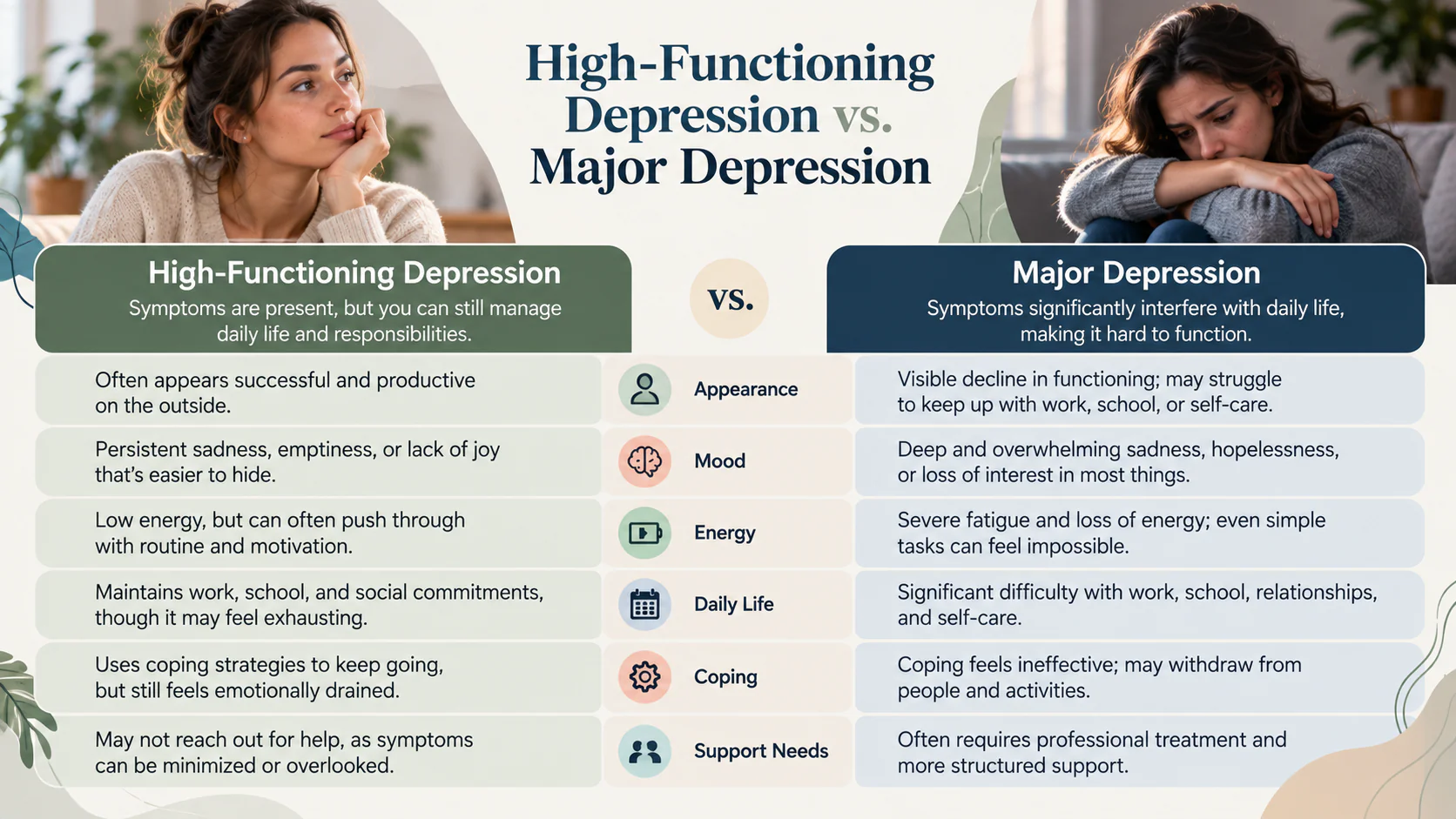
How High-Functioning Depression Differs From Major Depression
| High-functioning depression (often persistent depressive disorder) | Major depressive episode | |
| Duration | Long-lasting: two years or more | At least two weeks |
| Intensity | Often less severe, but constant | More severe, with more symptoms present |
| Daily life | Responsibilities are met, at a high personal cost | Work, home, and relationships are visibly disrupted |
| How it feels | “This is just how I am” | “Something is wrong” |
The two are not mutually exclusive. A woman living with long-term, low-grade depression can also develop a major depressive episode on top of it. And it is different from ordinary exhaustion: tiredness from overwork tends to lift with real rest, while depression follows you on vacation.
The Hidden Risks of Holding It Together
“Functioning” is not the same as being well. Left untreated, high-functioning depression carries real risks.
It can deepen. Persistent depressive disorder is long-lasting by definition. Waiting for it to pass on its own rarely works.
Drinking can creep in. Research published by the National Institute on Alcohol Abuse and Alcoholism finds that women more often drink in response to negative emotions. The institute also reports that among people with major depression, 27% to 40% will have an alcohol use disorder at some point in their lives. We explore that loop in depression and substance abuse.
Thoughts of suicide can be present even when life looks fine. Functioning does not protect against them. If you are having thoughts of ending your life, call or text 988 to reach the Suicide and Crisis Lifeline, any time of day.
How High-Functioning Depression Is Treated
High-functioning depression responds to treatment. The first step is an honest assessment with a clinician. You may be asked to complete the PHQ-9, a nine-question screening tool. A screening score is a starting point for a conversation, not a diagnosis.
From there, treatment often includes:
- Therapy. Cognitive behavioral therapy helps loosen the harsh, automatic thoughts that keep depression in place. Acceptance and commitment therapy helps reconnect daily life with what matters to you.
- Self-compassion work. For women whose depression is wrapped up in perfectionism, mindful self-compassion can be a turning point.
- Looking underneath. In the 2025 study mentioned above, people with more signs of high-functioning depression also reported more trauma. When unresolved trauma is driving the depression, trauma therapy is part of the answer.
- Medication, when appropriate. This is a decision to make with a prescriber who knows your history.
- Care for the body. Sleep, movement, nutrition, and time outdoors support recovery.

How Villa Kali Ma Can Help
Many of the women who come to Villa Kali Ma were the last ones anyone expected to need help. We understand what it costs to keep up appearances, and we offer a place to set that down.
Our approach to depression treatment for women is both clinical and holistic, in women-only settings. For women who need to keep working or caring for family, our intensive outpatient program in Del Mar offers three hours of programming per day. For women who need to step away and reset, The Retreat in Rancho Santa Fe offers residential mental health and trauma treatment.
Frequently Asked Questions
Is high-functioning depression a real diagnosis?
No. It is a descriptive term, not a formal diagnosis. A clinician may diagnose persistent depressive disorder or major depressive disorder, depending on your symptoms and how long they have lasted.
Can you be depressed and still be successful?
Yes. Many women with depression hold demanding jobs and care for families. Meeting your responsibilities does not mean you are not depressed. It often means you are working much harder than anyone can see.
How do I know if it is high-functioning depression or just stress?
Stress usually eases when the pressure lifts or when you get real rest. Depression stays. If low mood, loss of pleasure, or exhaustion have lasted most days for two weeks or more, talk with a professional.
Does high-functioning depression go away on its own?
Usually not. Long-term, low-grade depression tends to persist without treatment and can deepen into a major depressive episode. It does respond to treatment, including therapy and, when appropriate, medication.
You Do Not Have to Fall Apart to Deserve Help
If you saw yourself in this, you do not need to wait until you cannot function. Struggling quietly is still struggling, and it is reason enough to reach out.
Villa Kali Ma offers residential and outpatient programs for women in San Diego County. We provide free, confidential consultations and accept most PPO insurance plans. Call (760) 350-3131 or reach out to our team today.
Sources
- Cleveland Clinic. Health Essentials article on high-functioning depression. May 2024.
- Persistent Depressive Disorder. StatPearls, National Library of Medicine. Updated August 2024.
- Brody DJ, Hughes JP. Depression Prevalence in Adolescents and Adults: United States, August 2021 to August 2023. NCHS Data Brief No. 527. April 2025.
- SAMHSA. National Survey on Drug Use and Health short report on women’s health. March 2026.
- Joseph JF, et al. Understanding High-Functioning Depression in Adults. Cureus. 2025;17(2):e78891.
- Guinle MIB, Sinha R. The Role of Stress, Trauma, and Negative Affect in Alcohol Misuse and Alcohol Use Disorder in Women. Alcohol Research: Current Reviews. 2020;40(2):05.
- NIAAA. Mental Health Issues: Alcohol Use Disorder and Common Co-occurring Conditions. May 2025.
- Kroenke K, Spitzer RL, Williams JBW. The PHQ-9: validity of a brief depression severity measure. Journal of General Internal Medicine. 2001;16(9):606-613.