

You have finally found a program that fits: women-only, trauma-focused, the right level of care. Then you learn it is not in your insurance plan’s network. For many women, the search stops there.
It does not always have to. A single case agreement is one of the least-known tools in health insurance, and in California the law gives you more leverage than most people realize. This guide explains what a single case agreement is, when insurers approve one, and how to ask.
What Is a Single Case Agreement?
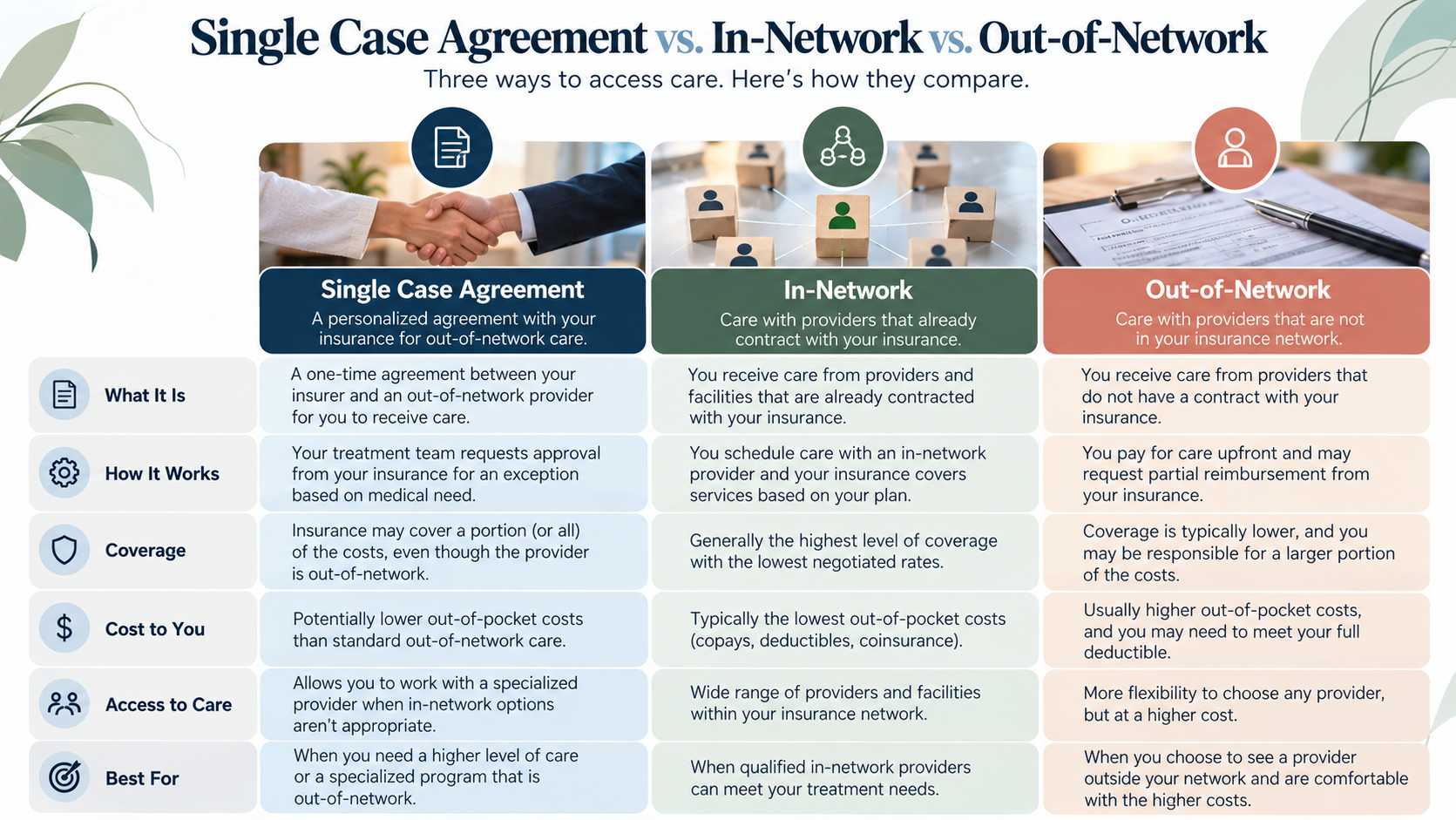
A single case agreement, or SCA, is a one-time contract between your health insurance company and a provider who is not in your plan’s network. It covers one patient, for one course of treatment.
The agreement usually spells out:
- Which services are covered, such as residential treatment or a partial hospitalization program
- The dates or number of days authorized
- The rate the insurer will pay the provider
- What you will owe
The point of a single case agreement is that you pay what you would have paid in network. That is different from using out-of-network benefits, where deductibles and coinsurance are often much higher.
When Will an Insurer Approve a Single Case Agreement?
Insurers do not grant SCAs because a member prefers a certain program. They grant them when the network cannot deliver the care that is medically necessary. The most common grounds are:
- No in-network provider offers the level of care you need. For example, your clinician recommends residential treatment and no contracted facility provides it.
- No in-network provider offers the specialty you need. Women-only trauma treatment is one example of a service that may be hard to find in a network.
- In-network providers cannot see you in time. Waitlists count.
- In-network care is too far away. Plans must meet geographic access standards as well as timing standards.
- Continuity of care. You are already in treatment and a change of provider would set your recovery back.
An SCA is never guaranteed. But when one of these situations applies, you are not asking for a favor. You may be asking for something the law requires.
Your Rights Under California Law
California has one of the strongest mental health coverage laws in the country. Under Senate Bill 855, if medically necessary treatment for a mental health or substance use disorder is “not available in network within the geographic and timely access standards set by law or regulation,” the health plan “shall arrange coverage to ensure the delivery of medically necessary out-of-network services.” The law goes on: “The enrollee shall pay no more than the same cost sharing that the enrollee would pay for the same covered services received from an in-network provider.”
A few details make this concrete:
- Timely access has numbers attached. For plans regulated by the California Department of Managed Health Care (DMHC), the standards are a non-urgent appointment with a mental health provider within 10 business days, a psychiatrist within 15 business days, and urgent care within 48 hours (96 hours if prior authorization is required).
- Your plan cannot stall. The DMHC has told health plans that they “may not delay an enrollee’s care beyond the applicable timely access standards due to a lack of a single case agreement or other arrangement with a noncontracting provider.”
- Your payments count. The same guidance says what you pay under such an arrangement applies to your in-network deductible and your in-network out-of-pocket maximum.
Which plans does California law cover?
These protections apply to plans regulated by California: health plans overseen by the DMHC and insurance policies overseen by the California Department of Insurance. A parallel provision in the Insurance Code covers the latter.
They generally do not apply to self-funded employer plans, where a large employer pays claims itself. Those plans are governed by federal law, and the U.S. Department of Labor oversees them. Federal mental health parity law still applies, and single case agreements are still possible, but the California requirements above do not bind those plans. Your HR department or your plan documents can tell you which kind of plan you have.
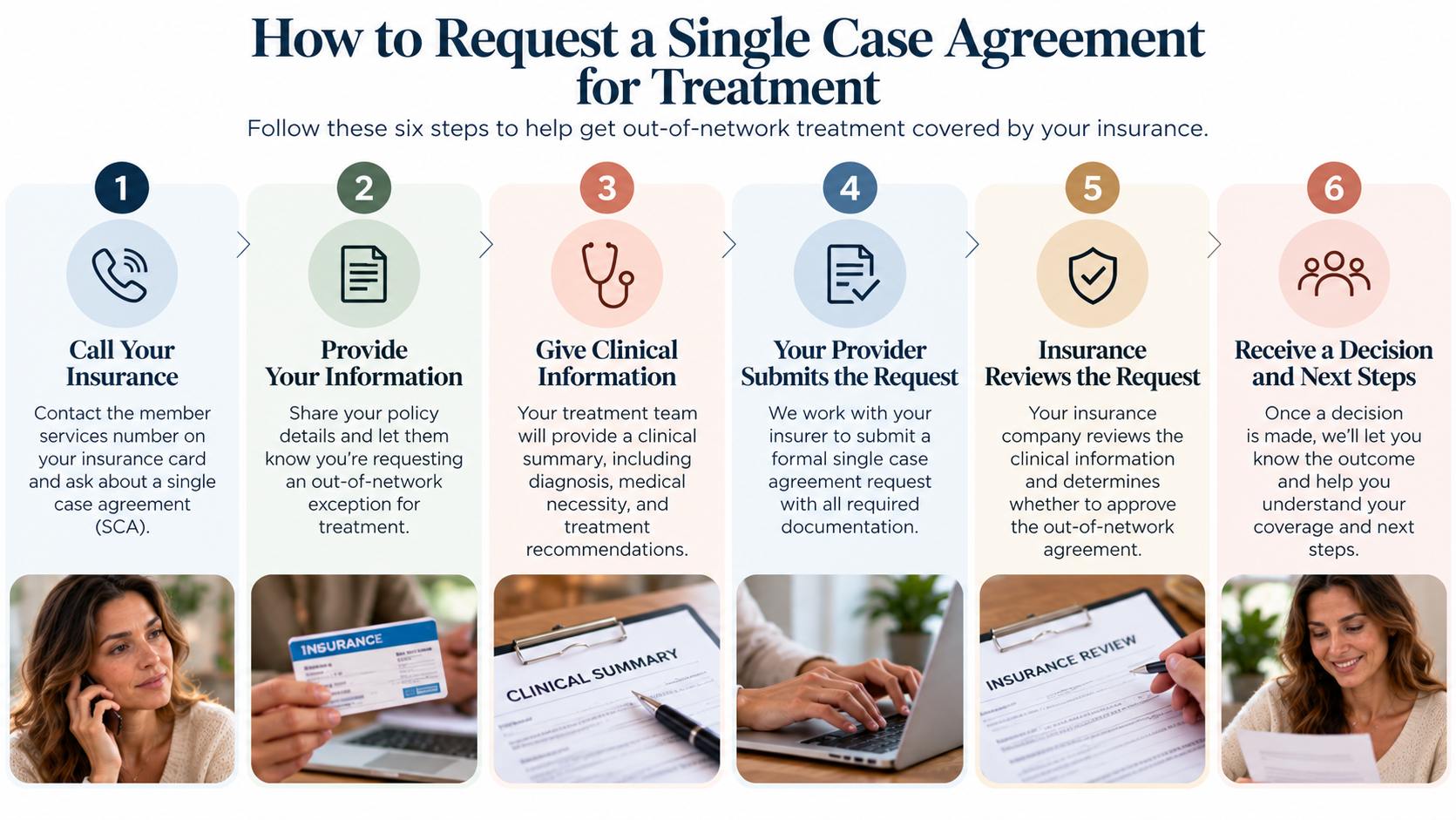
How to Request a Single Case Agreement, Step by Step
- Verify your benefits and your plan type. Find out whether the program is in network, what your out-of-network benefits are, and whether your plan is state-regulated or self-funded.
- Get a clinical assessment. An SCA rests on medical necessity. You need a clinician’s documented recommendation for a specific level of care.
- Ask your insurer for in-network options. Request a list of contracted providers that offer that level of care and specialty. Call them. Write down names, dates, and wait times. A documented gap in the network is the strongest case you can make.
- Make the request. Ask your insurer for a single case agreement with the provider you have chosen. In practice, the treatment program’s admissions or utilization review team usually handles the negotiation, including the rate and the authorization.
- Get the terms in writing. Confirm the services covered, the dates or number of days, and your share of the cost before you admit, whenever your situation allows.
- Expect ongoing reviews. Insurers typically authorize a set number of days and then review clinical updates before approving more.
If your need is urgent, say so, and ask for an expedited review.
What to Do If Your Request Is Denied
A denial is not the end of the road.
- File a grievance with your plan. Ask for the denial and the reason in writing.
- Go to the regulator. For DMHC-regulated plans, contact the DMHC Help Center at 1-888-466-2219. You generally need to go through your plan’s grievance process for 30 days first, unless your case is urgent.
- Ask for an Independent Medical Review. When a plan denies care as not medically necessary, an Independent Medical Review puts the decision in the hands of outside doctors. It is free and is usually decided within 45 days, or within 7 days for expedited cases.
- For insurance policies regulated by the Department of Insurance, call the consumer hotline at 1-800-927-4357.
- For self-funded employer plans, contact the U.S. Department of Labor’s Employee Benefits Security Administration at 1-866-444-3272.
Single Case Agreement vs. Out-of-Network Benefits
| In network | Out-of-network benefits | Single case agreement | |
| Contract with your insurer | Standing contract | None | One-time contract for you |
| What you pay | In-network cost sharing | Usually a higher deductible and coinsurance | In-network cost sharing |
| Approval needed | Authorization for the level of care | Often authorization for the level of care | A specific request, negotiation, and written agreement |
| When it applies | The provider is contracted with your plan | Your plan includes out-of-network coverage, as most PPO plans do | The network cannot provide the care you need |
How Villa Kali Ma Helps With Insurance
You should not have to become an insurance expert while you are trying to get well. At Villa Kali Ma, our admissions team offers free insurance verification and will explain your options in plain language.
Villa Kali Ma is an in-network provider with Anthem BCBS, MultiPlan, First Health, and Health Net, and accepts most PPO plans with out-of-network benefits. When a plan’s network cannot offer what a woman needs, we can pursue a single case agreement on her behalf. We do not accept Medi-Cal, Medicare, or other state-funded plans.
For a broader overview of coverage, see does insurance cover rehab. To understand the levels of care an agreement might cover, read about residential addiction treatment at The Villa, residential trauma treatment at The Retreat, and our partial hospitalization program.
Frequently Asked Questions
Who requests a single case agreement, me or the treatment center?
Either can start the process, and it works best when both are involved. You can ask your insurer directly, and the treatment program’s admissions or utilization review team usually negotiates the terms.
How long does a single case agreement take?
It varies by insurer and by how urgent the need is. Ask your plan for its timeline at the start, and request an expedited review if waiting would put your health at risk.
Does a single case agreement cover the full cost of treatment?
Not usually. It means you pay in-network cost sharing, such as your deductible, copays, and coinsurance, instead of out-of-network rates. Confirm your share in writing before treatment begins.
Can I get a single case agreement for residential treatment?
Yes, when residential care is medically necessary and your plan’s network cannot provide it within access standards. Approval is decided case by case and usually comes with a set number of authorized days.
You Have More Options Than You Think
If the right program is outside your network, do not assume the answer is no. Ask the question, document the gap, and let people who do this every day help you.
Villa Kali Ma provides free, confidential consultations and free insurance verification. Call (760) 350-3131 or reach out to our team, and we will look at your coverage with you.
This article is general information, not legal or insurance advice. Coverage depends on your specific plan. Laws and regulations change, so confirm current rules with your plan or the regulator.
Sources
- California Health and Safety Code section 1374.72(d) (Senate Bill 855, 2020).
- California Insurance Code section 10144.5(d).
- California Department of Managed Health Care. All Plan Letter 22-030. December 22, 2022.
- California Department of Managed Health Care. Timely Access to Care fact sheet. March 2025.
- California Department of Managed Health Care. File a Complaint and Independent Medical Review.
- California Department of Insurance. Help with a health insurance problem.
- U.S. Department of Labor, Employee Benefits Security Administration. Mental health parity enforcement.
- Triage Cancer. Understanding Single Case Agreements. December 2025.